
An Expert Guide to Towing With an Electric or Hybrid Vehicle
Hooking up to the future: towing with a fully electric or hybrid vehicle
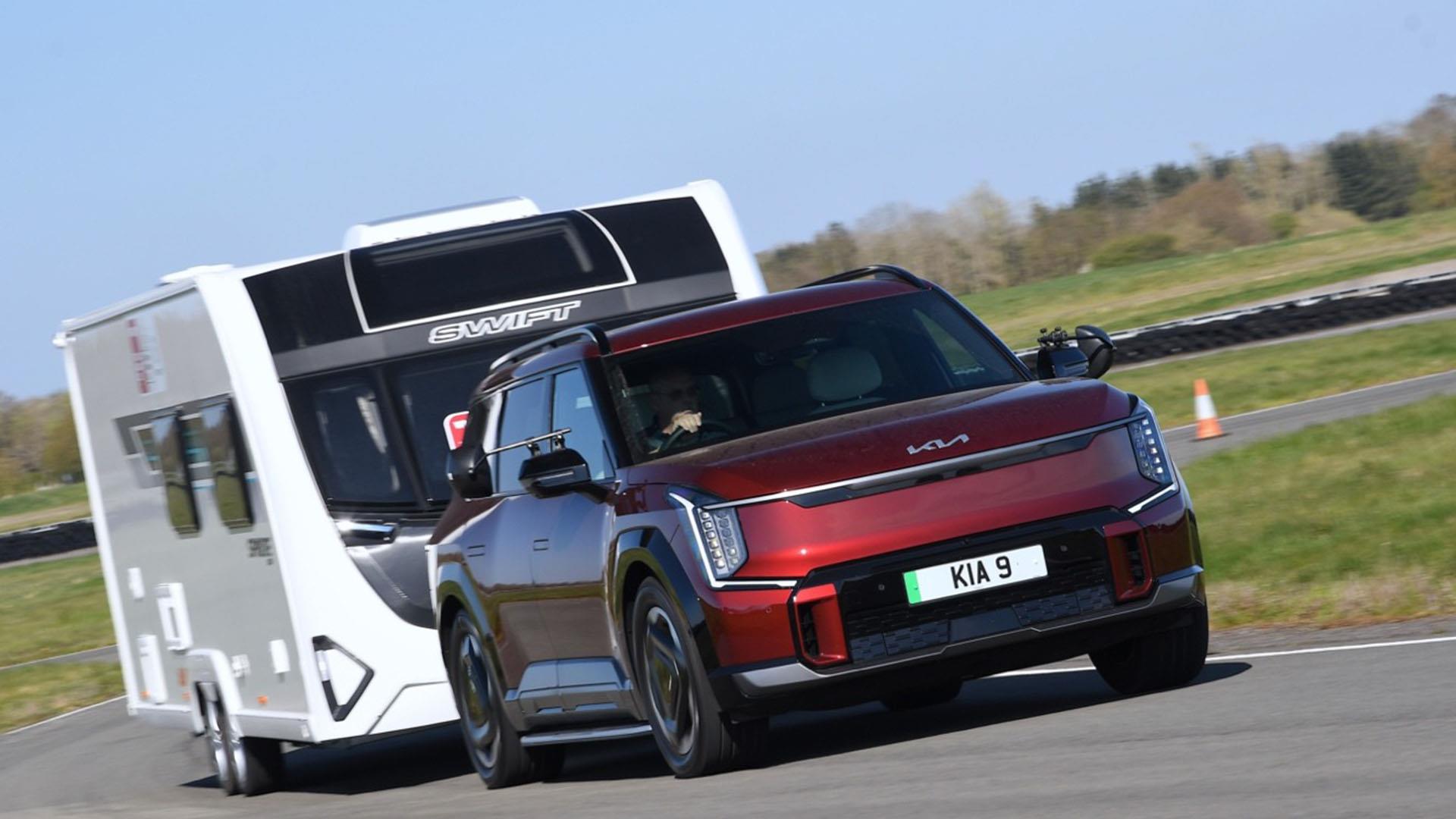
Towing with a fully electric vehicle (EV) or hybrid tow car needs a little extra thought. Our guide will help you understand what electric vehicles (BEVs) and hybrid electric vehicles (HEVs) are, their capabilities and limitations, and practical considerations when it comes to towing with one.
So if you’re considering buying or switching to an electric or hybrid vehicle for towing a caravan or other trailer, we’ll help you choose the best option for you.
The differences between electric, petrol and diesel vehicles
Traditionally powered petrol and diesel vehicles use an internal combustion engine (ICE) to burn fuel and drive the vehicle.
On the plus side, they are quick and easy to refuel at regular service stations, and are cheaper to buy than equivalent electric or hybrid vehicles.
However, ICE vehicles emit gases and small particles (known as particulates) as a result of the fuel-burning process. These emissions can be harmful to people’s health and the environment.
Also, the engine and its associated mechanical parts, such as the gearbox, have many moving parts that can wear and eventually need to be replaced.
Most low emission cars on the market today are powered solely or partly by electricity from rechargeable batteries.
Fully-electric vehicles must be plugged in to charge and use only battery power, delivered to electric motors that drive the vehicle’s wheels. They produce no tail pipe emissions on the road, and have fewer moving parts, so maintenance can be easier, cheaper or less frequent.
Hybrid vehicles have both a traditional combustion engine and motors powered by battery packs to drive the wheels. They help improve efficiency, and may give zero-emission driving for parts of a journey.
Electric and hybrid vehicles can be quieter and drive more smoothly than equivalent petrol or diesel ICE cars, and deliver a lot of pulling power (torque), which is good for towing trailers.
A growing movement to encourage drivers to use vehicles that produce fewer emissions on the road means the sale of new cars powered by pure fossil fuel will be banned in the UK from 2030, with a ban on fossil fuel hybrids to follow in 2035. Here's an in-depth look at the technology behind the different types of electric cars.
1. Battery electric vehicles
A fully electric vehicle, or battery electric vehicle (BEV), uses stored battery energy to power motors to drive the car’s wheels. The batteries are charged at en route charging stations or at home.
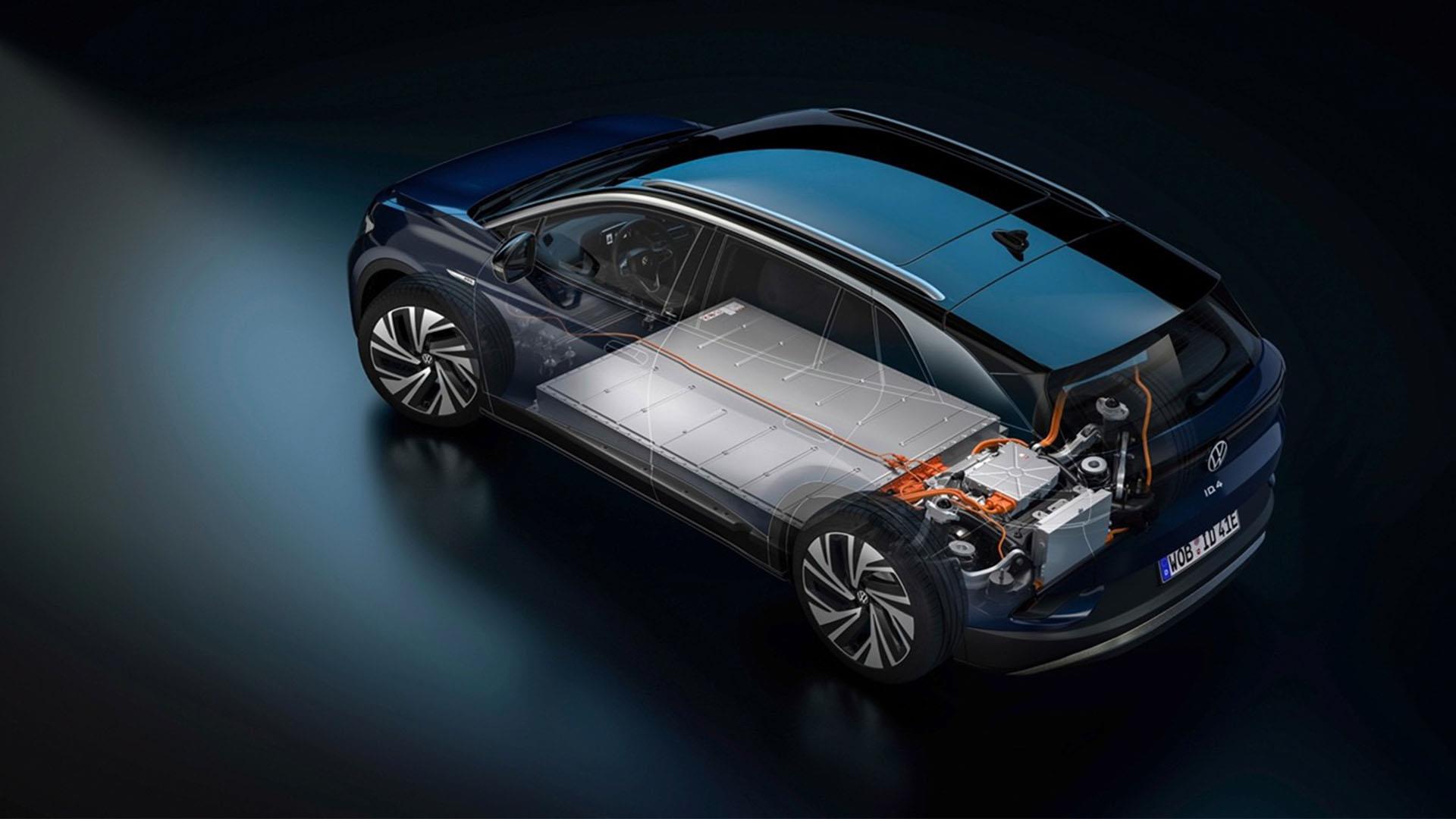
VW ID4 showing batteries low down under the passenger compartment and drive unit powering the rear wheels
The electric motors provide full torque instantly, making it easy to pull away from a standstill, ideal for those planning to use a BEV for towing.
With no tailpipe emissions on the road they are often known as zero-emission vehicles.
BEVs are a great choice when their electric range is sufficient for your driving needs, and you have the ability to recharge at home or at a nearby fast charger.
The position of the batteries, usually under the floor of the vehicle, means an electric car has a low centre of gravity, which helps with traction and stability.
Fully electric vehicles are often great for towing as they’re heavy, making it easier to match them with trailers and caravans, as long as they have an appropriate towing limit.
In recent years a growing number of BEVs offer towing limits of 1500kg or more, which is suitable for towing many family caravans.
Examples of BEVs capable of towing 1500kg or more include the Tesla Model Y, Kia EV6 and EV9, Polestar 3 and 4, Audi Q6 and many more.
2. Hybrid electric vehicles
Hybrid electric vehicles (HEVs) offer a blend of electric and ICE power, which can give advantages to those who want to tow. These include:
Engine Assistance
An electric motor powered by batteries can work together with the car’s engine when towing, giving extra pulling power when it’s needed and allowing you to drive further without recharging. There are several ways this can be implemented.
Some models only use the engine to charge the batteries – all the drive comes from electric motors. This is known as Series hybrid and is used in the e-Power Nissan X-Trail.
Others have a coupling to drive the wheels either by the electric motor or mechanically to the ICE – this is known as Parallel hybrid.
Additionally, there are systems that combine both of the above, called Series-Parallel hybrids that give the most flexibility. Some systems have electric motors on one axle and the conventional engine on the other, giving four-wheel drive. Note that you will still use more fuel while towing, as you would with a traditional-fuel car.
Engine and regenerative braking
When a conventional vehicle slows down, energy is lost through heat in the brakes and other moving parts. HEVs can capture this energy and use it to recharge the batteries. This can be beneficial, helping to boost the vehicle’s range. Sharp braking, however, can make regenerative braking less effective.
Battery management
Hybrid vehicles have computers to manage the balance between use of the electric motor and the engine during towing. There is often the option to choose when to use the battery to boost performance and it can be worth reserving the extra torque for hilly sections of your journey when you have a caravan on the back.
You may see full hybrids (FHEVs) on the market. Also known as self-charging hybrids, these offer a traditional engine combined with a battery and motor system.
There are different types of hybrid systems that can drive the wheels on either electrical power via motors, engine power via transmission or a combination of both. The batteries only charge while the engine is running, so once depleted they use more fuel (or energy from regenerative braking) to top up the battery.
FHEVs enable you to just add fuel like a traditional car, and can be a cheaper option than plug-in hybrid EVs. The system goes some way to improving emissions, especially in urban driving, while still offering loads of torque. They represent a good choice if home charging is not an option and towing a trailer is something you’ll only do occasionally.
Examples of hybrid electric vehicles capable of towing include the Ford Kuga FHEV and Kia Sportage HEV.
3. Plug-in hybrids - PHEVs
Plug-in hybrids (PHEVs) have both an ICE and an electric motor, powered by batteries, allowing home or public charging.
The batteries and motors can give a zero-emission range of 40 miles or more when not towing, so PHEVs can often be used for journeys around town or to commute without the engine starting.
PHEVs also often have very capable engines that can support towing without battery assistance, though the batteries can help when you’re pulling away or accelerating, as well as climbing hills.
From our experience of testing cars at the Tow Car Awards, the average PHEV can tow less than 25 miles on a fully-charged battery before it is depleted.
This is currently the most flexible electric vehicle, especially for those with home charging. PHEVs often have decent towing capacity and battery-only range for the commute, but tend to be more expensive than other hybrids.
Crucially, while towing there’s no risk of electric range anxiety, although you will need to refuel more often. A few examples are BMW X5, Volvo XC60 Recharge and VW Passat eHybrid.
4. Mild hybrids
Mild hybrids have small batteries and electric motors to support the vehicle’s engine for efficiency reasons. The engine never stops while driving, but the system can achieve decent fuel savings while driving solo. Torque and acceleration assistance from the electric motors is minimal, however. The battery is topped up using regenerative energy during deceleration or when the engine has spare capacity.
Mild hybrids are less commonly used for towing caravans, but may be suitable for lighter trailers and trailer tents.
As they are similar to traditional, fossil fuel cars, switching to a mild hybrid tow car requires little change in your habits, and is the least expensive electric or hybrid option.
Examples of mild hybrid cars capable of towing include the Suzuki Vitara, VW Golf eTSi and Hyundai Santa Fe.
How to choose the right electric vehicle for towing
Deciding which type of electric vehicle is suitable to your lifestyle and your towing needs is a personal one. It can be affected by many factors such as cost, whether you can charge it at home, how long your most frequent journeys are and whether regular stops for 30 minutes or more to charge is realistic, how often you plan to tow a trailer with it, the car’s towing capacity and its electric range – that is, the distance it can travel on a single charge.
As well as these general considerations, there are important specifics to consider.
Considerations when buying an electric vehicle
Can it tow?
Not all electric vehicles are approved – the technical term is ‘homologated’ – for towing. Of those that are, many have low towing limits, even if they look as if they could be good tow cars.
First, check the vehicle’s towing limit – if you can’t find one, the vehicle may not be approved for towing.
We highly recommend using the Club’s Towing Match Service, powered by TOWSAFE, which members have free access to. By entering a few vehicle details, they can match cars with caravans and produce a report (as shown below) to show they are a safe and legal match before committing to a purchase. Discover this and more with our Club membership.
Information about a vehicle is often available using its handbook, in the onboard computer, or online. If not, check with the dealer. You will need to check the tow car’s maximum towing capacity (the towing limit), towball limit, Gross Vehicle Weight (GVW) and Gross Train Weight (GTW).
If the handbook is not available, some of the above information will be printed on the car’s VIN plate, which is normally in one of the front door’s frames or under the bonnet.
However, be aware the maximum towing capacity is a measurement of the maximum weight the vehicle has been shown to tow up a hill with a specific gradient.
It is a standard test and does not suggest anything about the car’s performance while towing on the open road or with a caravan. For more information on this, see our Tow Car Awards testing and Expert Guide to matching car and caravan.
Cooling
EV systems can generate additional heat under the heavy load of towing, and batteries are heated or cooled automatically to control their temperature. There are two types of battery cooling in cars on the market today: air cooled and liquid cooled.
Look for cars with liquid cooling systems as they can cope better with the additional strain of towing. It’s important to check the vehicle’s handbook and refer to our Tow Matching Service to see if your chosen car has any limitation when towing to prevent damage or reduced performance caused by overheating.
Range
Range anxiety describes concerns that you will not have enough charge in the car’s batteries to reach your destination. The additional weight and aerodynamic drag caused by towing a caravan will reduce the car’s range.
We have tested more than 100 electric and hybrid vehicles during our Tow Car Awards testing and found a car’s range is typically reduced by half the normal solo driving distance while towing a caravan.
Towing lower profile trailers such as trailer tents, folding caravans and campers lessens that range reduction.
Our research also suggests many towing journeys are fairly short, so this may not be as much of an issue as some campers fear.
For longer journeys, it is important to plan your route and recharging stops to make things less stressful, especially since many charging stations cannot easily accommodate a car with a caravan attached.
You will find more details on the ranges achieved by cars when towing at our Tow Car Awards on Awards partner What Car?’s website.
The price and depreciation of electric vehicles
Electric vehicles typically cost significantly more than equivalent traditional ICE cars and their resale values are often lower.
However, assuming you normally recharge at home using a dedicated EV tariff, combined with less frequent maintenance costs, can go a long way to offsetting the premium paid at point of purchase. Many people also choose electric vehicles as a proactive step to reduce their carbon footprint.
Tax rates
Many electric vehicles, both BEV and hybrids, cost more than £40,000 when new and therefore incur higher Vehicle Excise Duty (VED or car tax). This Expensive Car Supplement is paid for the first five years of the car’s life, before the VED reduces to the standard rate for low emission vehicles (£195 in 2025).
Battery health
In the past there were concerns that EV batteries would degrade significantly over the years. The good news is they are proving to last a lot longer than feared.
If a car’s batteries are used and charged as recommended by the manufacturer, they can retain their charge and capacity for many years. This can include keeping the batteries charged between 20% and 80% of capacity in normal use, and using appropriate battery chargers.
Most new vehicles offer a long battery warranty with a guaranteed level of performance, which is typically 70% of the original battery capacity for up to ten years.
If you are buying a pre-owned car, check whether this warranty is transferable to a new owner and if there are any conditions attached.
We recommend asking for a certificate of battery health to establish the condition of the batteries. These are not common yet but will be introduced for new vehicles with the Euro 7 regulations. If there is the option to extend the battery warranty, it’s worth considering, to avoid any unexpected bills.
All-Wheel Drive systems
Two or four-wheel drive is often an option on electric vehicles. Four-wheel drive can improve traction and handling. Some four-wheel drive systems are engaged all the time while others are on demand. Whether you need this function in a tow car will depend on the type of camping you plan to do. You’re unlikely to need it on Club Sites with hardstanding pitches, but if you plan to go to Certificated Sites, Club Meets, Temporary Holiday Sites or other field-based campsites, all-wheel drive and more suitable tyres may be useful, especially in the winter.
Charging connectors
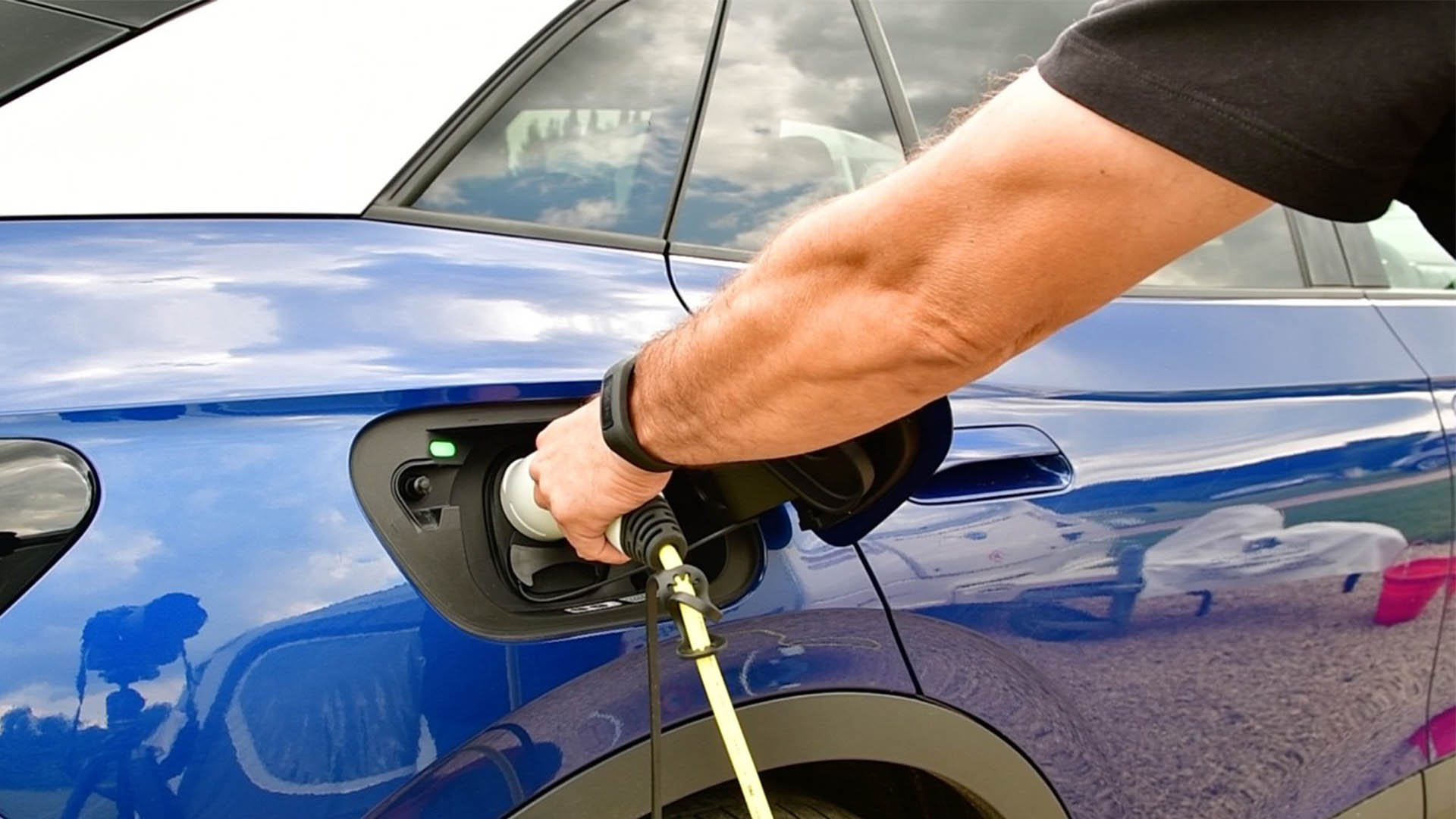
There are several different charging connectors fitted to fully electric and plug-in hybrid vehicles. Not all will suit your vehicle and not all public chargers will be compatible with your vehicle.
For example, much of the Tesla Supercharger network is only suitable for Tesla cars, except for a few locations that can be used by cars with a CCS connector (Combined Charging System).
If you buy an electric or plug-in hybrid tow car, make sure you are able to identify suitable charging points and have appropriate adaptors if you need them. Your dealer should be able to give guidance here.
Insurance
As with all types of towing, it’s important to check your car insurance policy will cover your trailer when you are on the road. The Club’s insurance provider Club Care will automatically cover the trailer (third party cover) and you can ask about additional cover for the trailer or caravan itself and all your other equipment .
Other towing safety factors
There are several other considerations regarding towing rules of the road including mirrors, speed limits, your driving licence and more, so we recommend reviewing our towing safety advice.
Towing trips with an EV - plan, park and plug-in
Towing will significantly reduce the range of a fully-electric vehicle, so make sure it is fully charged and pre-cooled or pre-heated as needed before leaving home, to give you as good a range as possible.
Plan your route to avoid long up-hill sections, sticking to major routes if you can, and take advantage of regenerative braking where possible by looking well ahead and anticipating when you will need to slow down.
Even with the most careful driving, if you are travelling a long way you are likely to need to stop to recharge. If you only have one driver, they should take a break every two hours, so try fitting around this.
A rapid charger should be able to top up a vehicle from 20% to 80% within an hour. If the car can use an ultra-fast charger and one is available, you will pay a premium for the service, but you will be on the move again more quickly.
The main issue with en route charging while towing is finding a drive-through bay or similar that enables you to avoid unhitching the caravan while you charge the tow car. These are in very short supply, although Gridserve and Instavolt both have some stations that can accommodate an EV while towing.

Instavolt’s Winchester service Station with van and towed unit charging on the left
If your car does not have an inbuilt facility to find a local station (such as in the Tesla app), there are several apps that can help, including:
- Gridserve
- Zapmap
- Instavolt
These will identify the type of connection and speed of charge. Also consider the positioning of your car’s charging connection while towing relative to the charging socket before arrival at the charging bay.
Unhitching to charge
If no suitable pull-through chargers are available, you will need a plan to unhitch the caravan or trailer when you need to recharge the tow car.
If you need to unhitch the caravan to charge your tow car, make sure you choose a bay that allows you to return to the caravan as motorway service areas are often not clearly signposted. Use Google Street View or similar to check – preparation is the key for towing on long journeys.
Practical safety and security issues
An unhitched caravan or trailer is vulnerable to theft in a public space, so make sure you fit appropriate security devices (often required by insurers) and ideally leave an adult with the trailer.
It’s worth checking whether you need to pay to leave your caravan or trailer in a car park for any length of time, or how long free parking is available.
Take extra care when you return to your caravan as most other drivers won’t be expecting a vehicle going the opposite way to the normal flow. When hitching up, carry out all your normal safety checks – as in our hitching checklist.
Campsites and EV charging
If you stop at a campsite on your journey, you may prefer to choose one that offers dedicated EV charging, making the additional stops part of your holiday. Some campsites have EV chargers, such as our Hereford Club Site. Look for the electric vehicle charging point symbol in SiteSeeker.
On other Club Sites, if there is no dedicated charging point you can trickle charge your car’s batteries on the pitch if you have an electric hook-up. The car must only be connected to a 13A socket in your caravan, using the caravan’s controlled supply, so discuss the suitability of your wiring for this purpose with your local caravan workshop.
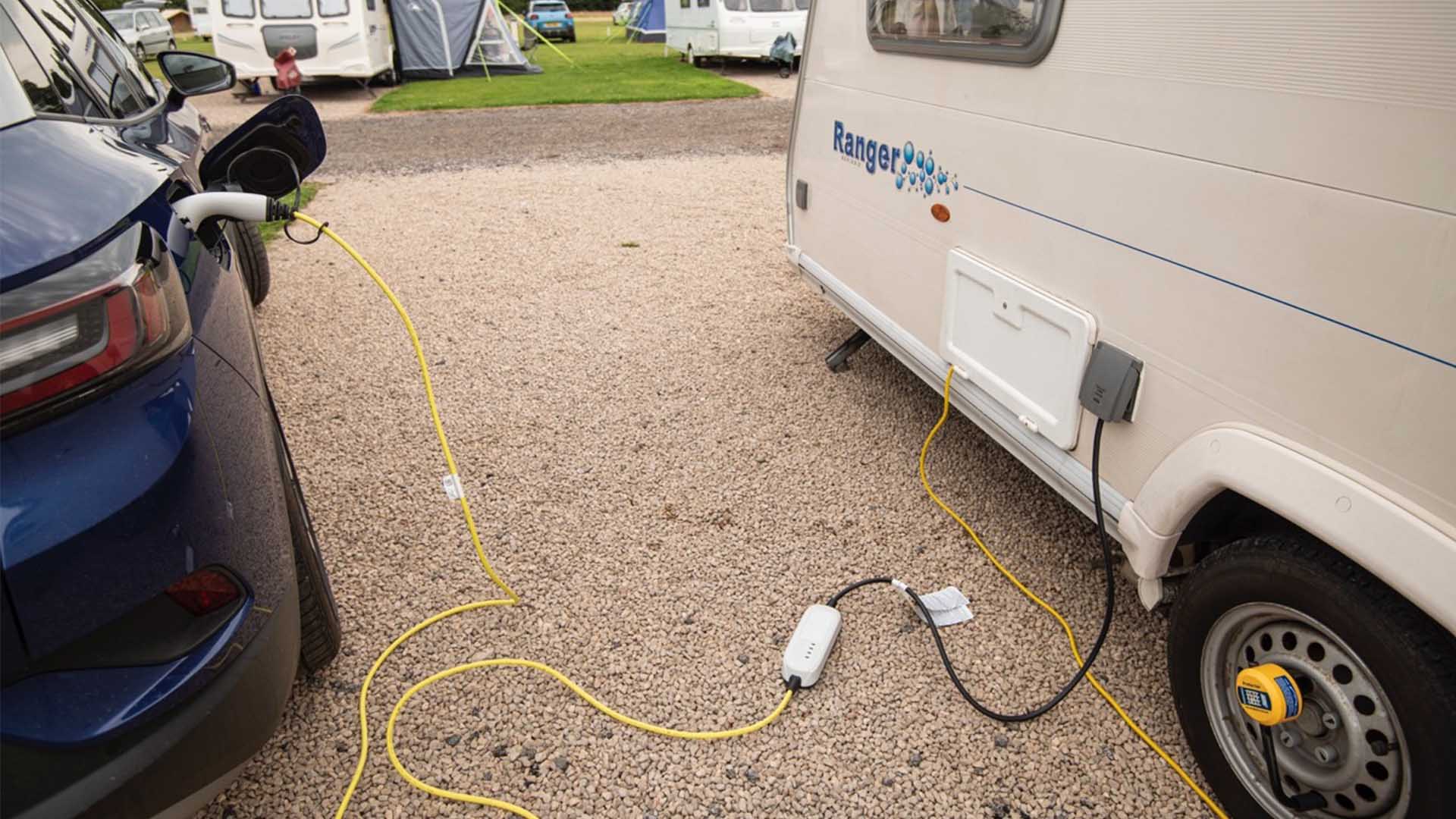
Charging on your pitch must only be via the electrical circuits within your caravan
Charging will be slow, taking around 30 hours to recharge a 60kWh BEV, but an overnight charge may be enough to top-up and complete your towing journey or reach a nearby fast charger the next day.
When camping at sites without electric hook-ups, it's important to plan ahead by locating the nearest EV charging station and ensuring your battery has enough charge to reach it.
Hybrid tow car considerations
Hybrids do not need to charge as regularly as fully-electric vehicles, as most can operate without the battery support, but once the battery is depleted, fuel consumption will increase so you will need to fill up with petrol or diesel more often.
Major road service stations should be able to take a car towing a caravan, but smaller forecourts may not have the capacity so it’s worth checking them out beforehand.
Depending on how the HEV is set up, a depleted battery may affect performance when pulling away at a junction, or acceleration. The engine must work harder in these conditions.
Final thoughts
Service and maintenance
Regular servicing is important for all vehicles and trailers as towing creates extra stresses. Battery electric tow cars are simpler to maintain but suspension and tyres can wear more quickly than in traditional ICE vehicles.
Hybrids have the traditional car’s requirements for servicing with the addition of the battery, motor and associated systems, so tend to be more complicated.
In the UK we have no mandatory safety test for trailers - it is the driver’s responsibility to ensure it is roadworthy. We highly recommend having your caravan or trailer serviced by a professional, such as the Approved Workshop Scheme for caravans or National Trailer and Towing Association for trailers. It’s also worth noting that an electric-powered tow car is likely to increase wear on the hitch and overrun brakes than an ICE one, so factor this in at service time.
Breakdown and recovery
If you are unfortunate enough to breakdown on your journey, be aware that garages and recovery agents require specialist training to work with electric vehicles but not all are able to do so.
RAC’s roadside staff are all trained and have the required equipment to assist EV users. A recovery service can pay for itself in a single incident, but look for one that will recover your caravan as well as your electric vehicle, such as RAC Arrival.
If an EV breaks down and is in immediate danger (such as in a live traffic lane), it can be towed slowly a short distance to a safe location to await further assistance, just like any other vehicle. When an EV is towed any distance, many manufacturers require all wheels to be off the ground. This is not a new challenge and recovery operators are generally used to this.
Top tips for towing with an electric vehicle
- Plan for longer travel times and charging breaks as needed
- Follow the manufacturer’s advice on keeping your car’s batteries within 20%-80% charge range for best life
- Towing mode - check your car’s handbook for specific actions and modes for towing
- Avoid frequent rapid charging
- Maintain a moderate speed, to avoid excessive aerodynamic drag
- Drive smoothly, looking ahead to predict traffic flow and avoid excessive acceleration and braking to give the best possible range
- Only pack what you really need in the car and caravan, reducing the weight can help get a few more miles range
- If travelling outside the UK check warranty coverage and charger availability for your chosen route.
EV glossary
Torque An engineering term that’s used to describe the force available to turn the car’s wheels. Electric vehicles generally have high torque as soon as you press the accelerator, making them good tow cars.
kW and kWh The power used by a car as it drives along the road is measured in kilowatts (kW) - the more you speed up, the more power is needed. If you use 1kW of power for an hour, that is a measurement of the energy used – 1kWh. The kWh is therefore a unit of energy, used to measure the capacity of an electric vehicle’s battery.
Towing Limit This is the maximum weight your vehicle can legally tow, as stated by the vehicle’s manufacturer.
Nose weight The downward force the trailer exerts on the tow ball.
Maximum Authorised Mass (MAM), Maximum Gross Weight (MGM) or Gross Vehicle Weight (GVW) The maximum a vehicle is allowed to weigh when it’s fully loaded with passengers and kit.
Gross Train Weight (GTW) The maximum an outfit, such as a combination of a car and caravan, is allowed to weigh when fully loaded.
Series Hybrid system The electric motors always drives the road wheels and the internal combustion engine (ICE) charges the batteries as a generator. This ICE operates at its most efficient so works well for city driving. They tend to be simpler in design but are less suited to towing heavy loads for long distances.
Parallel Hybrid system Both the internal combustion engine and the electric motors can directly drive the road wheels separately or simultaneously. Parallel hybrids allow the ICE to power the road wheels so are a more efficient use of power. Larger batteries and motors help improve torque and towing capacity potential. They are good at providing constant high speeds and long distance towing.
Series-Parallel Hybrid system A combination of the above hybrid systems so far more flexible but more complicated.